Product
·
Published
15 Jan 26
Why product teams drown in tools but starve for insight
Intelligence scattered across departments and external sources. Patterns invisible in disconnected tools. Why unified customer intelligence is the only way forward.

Dennis Green-Lieber
·
5
min read
Table of content
The customer intelligence OS for modern product companies.

You have data everywhere. Intelligence scattered across departments and sources you don't control.
NPS scores in one platform. Support tickets in another. Sales call recordings in Gong. User interviews scattered across Dovetail, Notion, and someone's Google Drive. Feature requests in Productboard. Usage data in Amplitude. Customer profiles in your CRM. Feedback comments in Slack threads you'll never find again.
Your company uses hundreds of SaaS applications, you personally toggle between so many tools just to do your job as a product manager.
You're drowning in tools but starving for insight.
The problem: Feedback lives everywhere, patterns live nowhere
The issue isn't that you lack data. You have endless data.
Customer success logs every conversation. Sales records every call. Support captures every complaint. Users leave feedback in-app, on review sites, in community forums, during onboarding surveys.
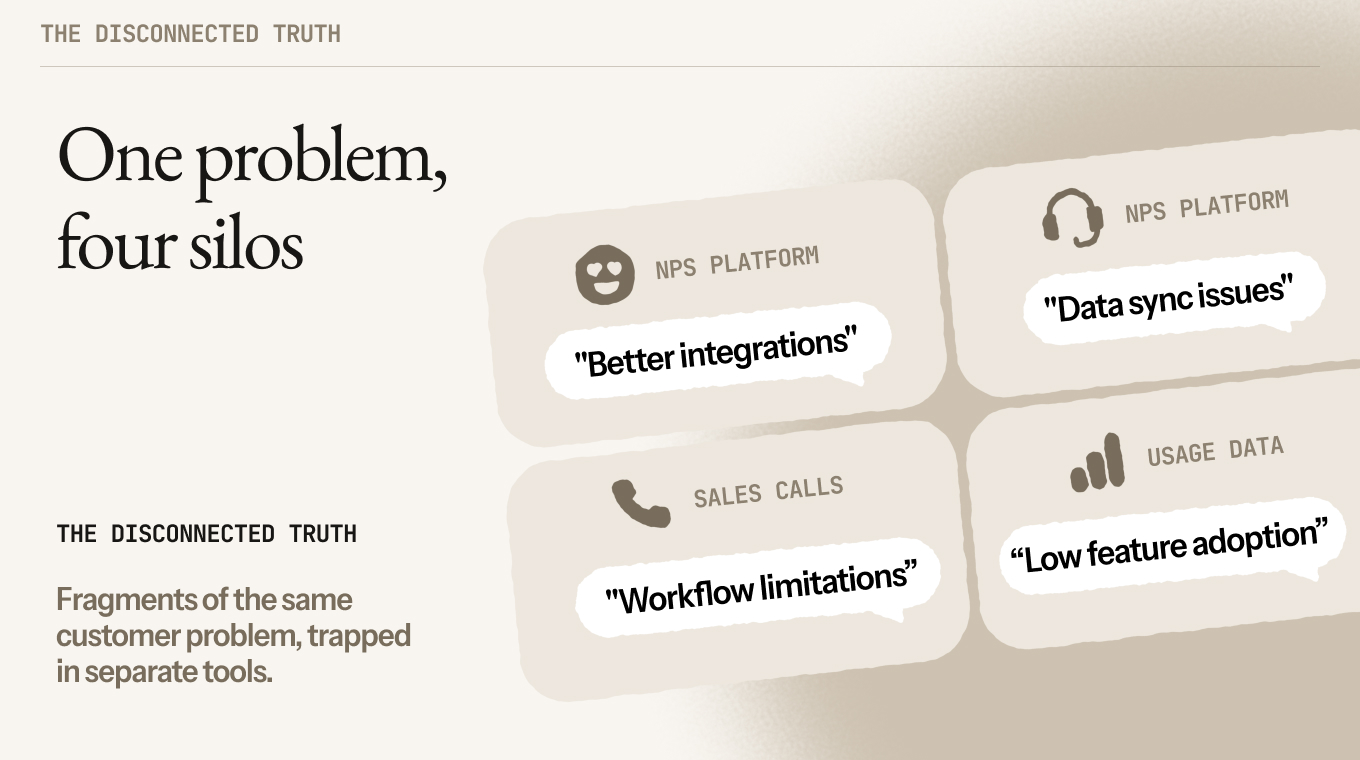
The problem is that all this intelligence lives in disconnected silos.
When you need to answer "should we build feature X," you open seven tabs. You check the NPS comments. You search support tickets. You ask sales what prospects are requesting. You dig through old research notes. You look at usage data.
Then you manually piece it together in your head. You make a spreadsheet. You build a slide deck. You present your "analysis" which is really just your best guess based on the fragments you could find and remember.
By the time you synthesize across tools, the decision moment passed.
The sprint planning meeting was yesterday. Engineering already started building based on whoever's input arrived first. Your research gets filed under "good to know" instead of driving the roadmap.
This is the stitched stack problem. Every tool captures a snapshot of customer truth. None of them connect. You're collecting without activating.
Most teams solve this by adding another tool
When insight is scattered, the instinct is to add another analysis layer on top.
You buy a customer data platform to unify everything. You implement a business intelligence tool to create dashboards. You hire a data analyst to write SQL queries. You subscribe to an AI analysis tool that promises to "surface insights automatically."
But adding more tools doesn't solve tool sprawl.
Now you have more tools instead of fewer. The CDP becomes another silo. The dashboards show what happened, not what to do. The AI analysis summarizes feedback you still can't act on because it's not connected to who said it, why they said it, or what it means for your roadmap.
Then there's the new wave: AI-savvy teams building their own solutions. Smart product teams using MCPs (Model Context Protocol) and AI agents. They're configuring custom connections, writing prompts, building workflows to query across their data sources.
This works... if you're technical enough to set it up and have time to maintain it. But here's the problem: it's single-player mode.
Your brilliant AI setup lives in your terminal or your personal ChatGPT workspace. Your PM colleague can't access it. Your designer can't use it. Your eng lead can't see it. When you're on vacation, the intelligence stops. When you leave the company, it disappears.
Most teams don't have someone with the skills to build and maintain this. Even teams that do quickly realize they've created a fragile, person-dependent system that breaks the moment that person is unavailable.
You don't need another tool to configure. You need infrastructure that just works.
The fundamental problem isn't analysis. It's that feedback lives in disconnected systems and you're trying to run a product with a fractured view of customer truth. Whether that's tool sprawl or a brilliant single-player AI setup, the core issue remains: customer intelligence isn't multiplayer, isn't persistent, and isn't accessible to everyone who needs it.
The solution: One unified intelligence layer
Propane doesn't add another tool to your stack. It replaces the stitched approach with a Customer Intelligence OS where everything connects automatically.
Your NPS scores, support tickets, sales calls, user interviews, feature requests, usage data, and customer profiles live in one system. Not exported and imported. Not synced with delays. Actually unified.
When a customer mentions a problem in a support ticket, you see their usage patterns, their past feedback, their interview responses, their account details, and every other signal they've given you. All in one place.
This is the altitude shift. You stop toggling between tools trying to piece together customer truth. You see connected intelligence that shows you who people are, what they do, and what signal they're really giving you about value.
How it works
Propane auto-connects to everything. Your support system, your call recordings, your survey tools, your CRM, your product analytics, your community forums. No complicated technical setup. No MCP configuration. Completely turnkey.
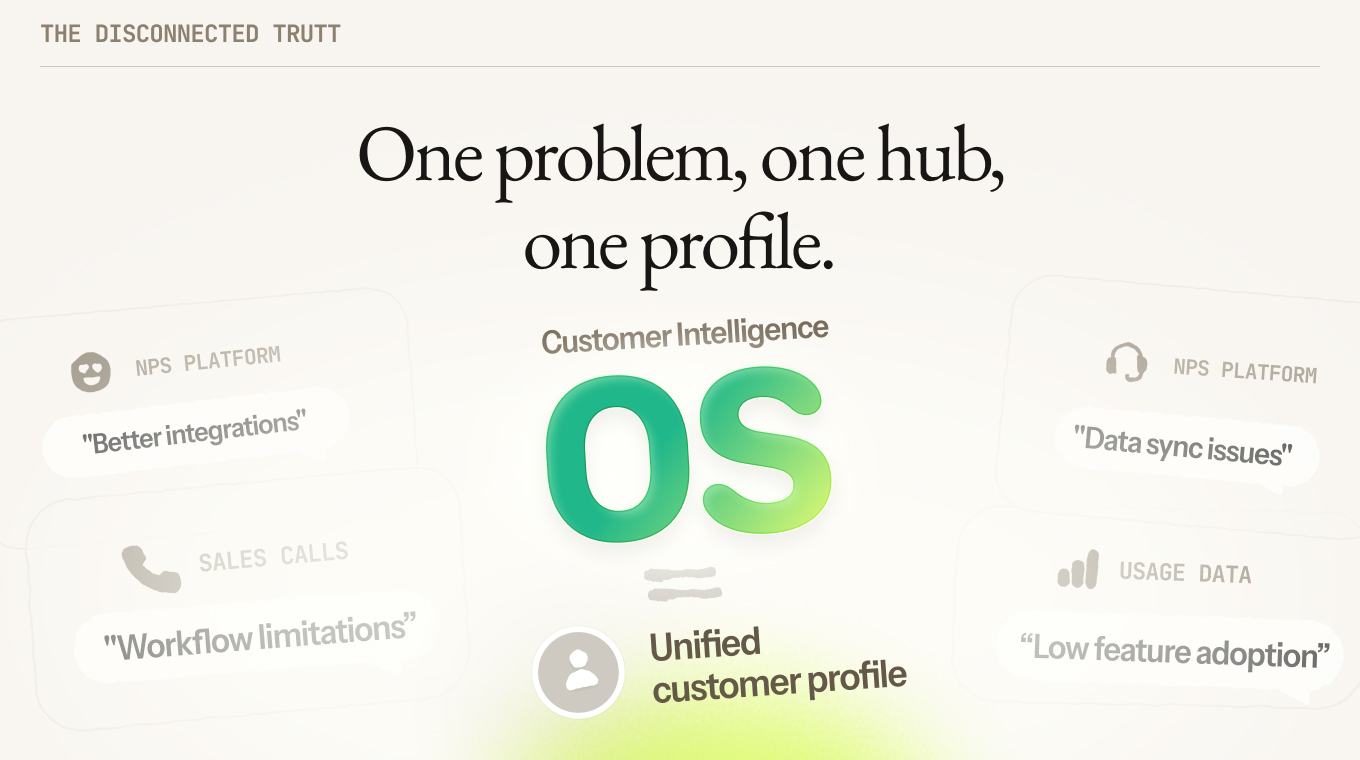
It creates connected datasets, not clusters you analyze manually. When feedback comes in from any source, Propane links it to the customer profile, their usage patterns, their segment, their history, and related signals from other customers.
You get a CRM-like system for customer intelligence. Every piece of feedback is connected. Every customer has a complete profile. Every pattern is visible across your entire dataset.
When you need to answer "should we build feature X," you don't open seven tabs. You open Propane and see 47 customers mentioning the same underlying problem using different words across support tickets, sales calls, and interviews. You see which segments they're in, whether they're at risk of churn, whether they represent expansion opportunity.
The intelligence is already synthesized. Your job is deciding what to do with it.
What happens when intelligence is actually unified?
Product teams using unified intelligence make decisions 10x faster because they stop spending days hunting for scattered feedback and weeks synthesizing it manually.
They catch problems earlier because patterns emerge across all signals simultaneously instead of showing up in one tool months before appearing in another.
They align cross-functionally because everyone sees the same customer truth instead of arguing about whose tool has the "real" data.
What unified intelligence unlocks
A B2B platform had intelligence scattered everywhere. NPS comments said customers wanted "better integrations." Support tickets mentioned "data sync issues." Sales calls referenced "workflow limitations." Usage data showed low adoption of a key feature meant to address these issues.
Were these four different problems or one problem described four different ways? Product managers spent 40% of their time gathering fragments from disconnected tools, trying to answer this question. Every roadmap decision required a week of data archaeology.
They implemented Propane as their unified intelligence layer.
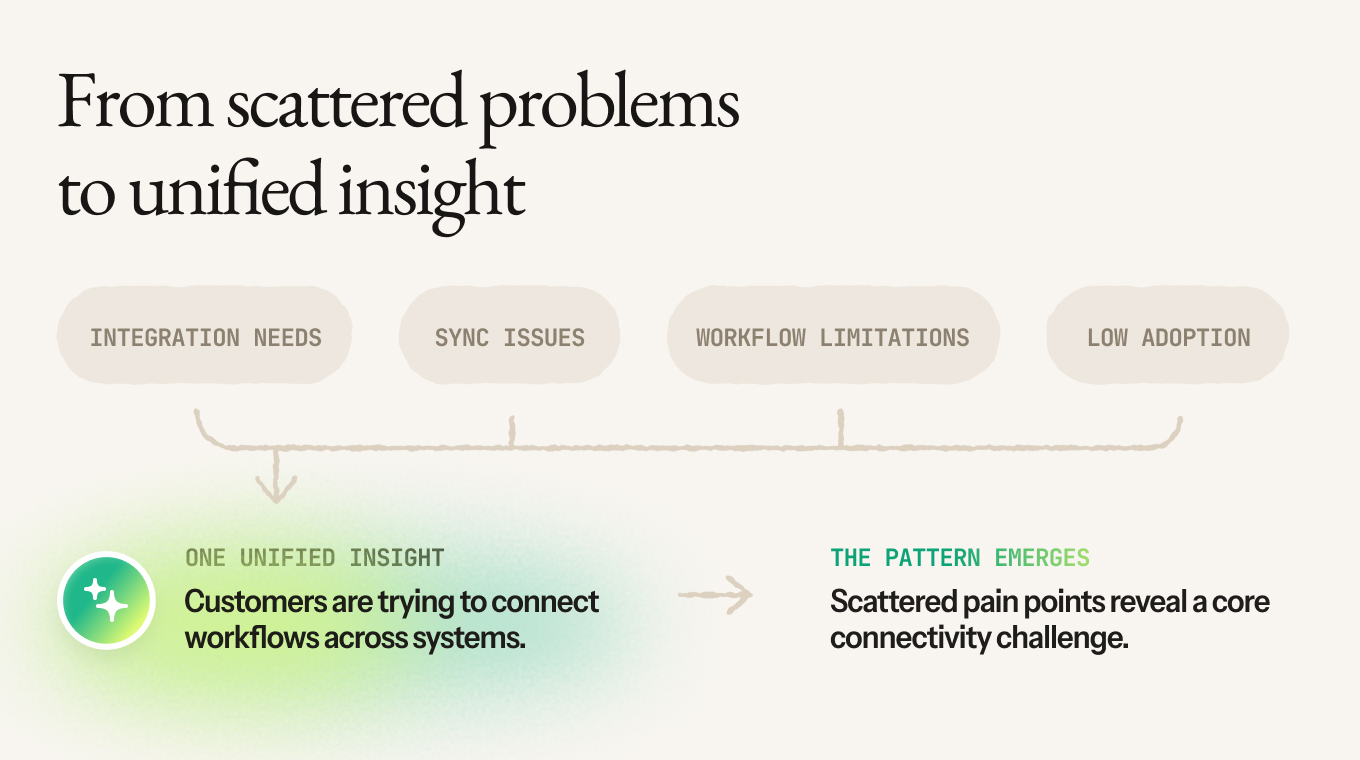
Within 30 days, the pattern emerged.
(image that shows four separate "problems" converging into one unified insight: "Customers trying to connect workflows across systems")
The four "problems" were actually one underlying issue. Customers were trying to connect their workflows across systems, hitting limitations, and describing the friction differently depending on who they talked to.
NPS respondents called it "integration needs" because that's survey language. Support tickets called it "data sync issues" because that's how users describe technical problems. Sales prospects called it "workflow limitations" because that's business language. The feature with low adoption was supposed to solve this but missed the actual job.
This pattern was invisible when signals lived in separate tools. It became obvious when everything connected.
What changed:
Decision speed: Roadmap decisions that took a week now took an hour. The team shipped a solution in 6 weeks instead of spending another quarter debating which "problem" to prioritize. Because they weren't solving four problems. They were solving one job that 89 customers were hiring them to do.
Time allocation: Product managers went from spending 40% of their time on data archaeology to 5% reviewing synthesized intelligence. That's 14 hours per week per PM redirected from gathering fragments to making product decisions.
Cross-functional alignment: Debates ended faster because everyone looked at the same unified intelligence instead of arguing about whose tool was right. Roadmap planning changed from "what should we build" to "here's what customers need, ranked by impact." The research was already done continuously across all sources. Planning became prioritization.
Feature adoption: The unified solution hit 67% adoption in month one versus their 23% historical average. When you solve the actual job instead of surface-level requests, customers use what you ship.
The shift wasn't just operational efficiency. It was strategic clarity. They stopped guessing what mattered and started knowing.
Why unified intelligence works when tool sprawl doesn't
More tools create more silos. Each tool captures one slice of customer truth but can't see the whole picture.
Dashboards show you snapshots from individual tools. They can't reveal patterns that only emerge when you connect signals across tools.
AI analysis only works on the data you feed it. If that data is fragmented across 13 disconnected systems, the AI analyzes fragments, not truth.
The breakthrough isn't better analysis. It's unified data.
When feedback from every source connects to complete customer profiles, patterns become visible that were impossible to see before. When the same customer mentions the same problem in three different contexts using three different words, you recognize it's one problem, not three.
When every signal is timestamped and connected, you see how needs evolve over time instead of taking periodic snapshots that miss the progression.
When everyone in your company sees the same customer intelligence instead of their tool's version of it, decisions happen faster and with more confidence.
Getting started with unified intelligence
Connect Propane to your existing tools. Support, calls, surveys, CRM, analytics, community. This takes hours, not weeks.
Let Propane unify everything into connected customer profiles. Every piece of feedback links to who said it, their usage patterns, their segment, their history.
Start asking questions you couldn't answer before. "Which customer segment mentions integration needs most?" "How does this feature request correlate with churn risk?" "What problems do high-value customers describe that others don't?"
The intelligence is already there in your scattered tools. You just need it connected so you can actually see it.
Want to see how unified intelligence changes product decisions? Book a demo.
Customer truth, unified. Not scattered across 13 tools you'll never synthesize.