GTM
·
Published
16 Jan 26
Your CRM says you lost to price. Your buyer says otherwise: The 85% gap
Your CRM says price. Buyers say implementation timeline. 85% of closed-lost reasons are wrong. Here's how AI agents get the truth.

Dennis Green-Lieber
·
5
min read
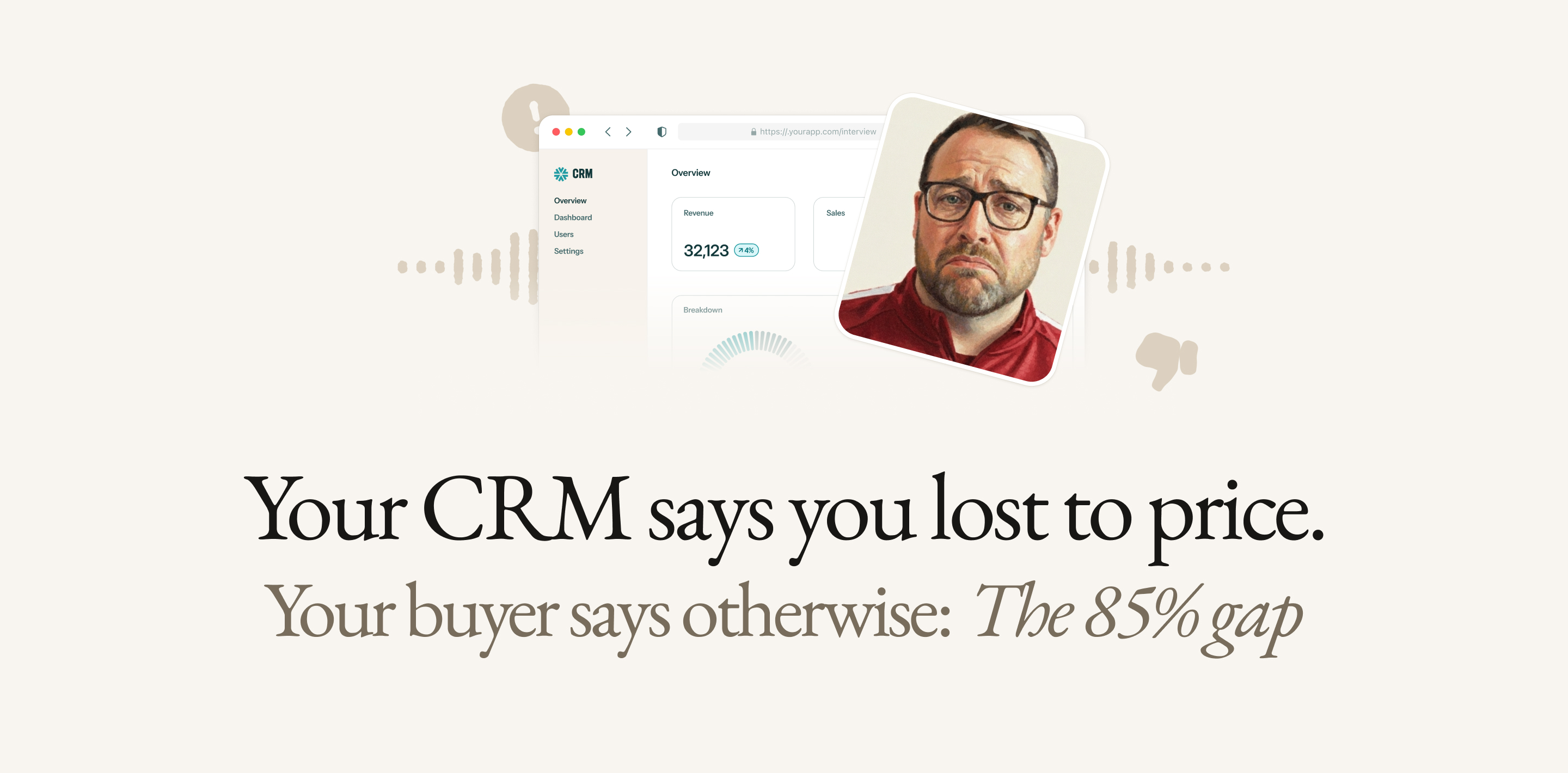
Table of content
The customer intelligence OS for modern product companies.

Except the buyer who actually made the decision says price wasn't even top three. They went with your competitor because of implementation timeline. Or because your champion left mid-deal. Or because leadership changed priorities and the project died.
Your CRM and reality only match 15% of the time.
85% of closed-lost reasons in your CRM don't reflect what actually happened. But here's what's worse: your closed-won reasons are just as fictional.
Reps mark "product fit" when the real reason was your competitor's implementation took 12 weeks and yours took 3. They mark "price" as a win factor when the buyer actually chose you despite higher price because your champion had been burned by the competitor before.
Roughly 65% of competitor data is wrong on both wins and losses. 61% of deals you think you lost to competitors were actually lost to indecision, but there's no CRM dropdown for "they just didn't do anything."
When you don't know why you actually win, you can't replicate it. When you don't know why you actually lose, you can't fix it.
Your revenue strategy is built on fantasy data in both directions.
The problem: Reps can't see inside buying committees
Sales reps pick the easiest dropdown option. They guess. They repeat what the champion told them without knowing what actually happened in the executive meeting where the decision was made.
60% of the time, sales reps are wrong about why they win or lose deals.
This isn't because reps are lazy or incompetent. It's because they have limited visibility into buyer decision processes. Prospects don't share full information. Buying committees make decisions behind closed doors. Your champion thinks it was price. The CFO killed it because of contract terms. The VP had a bad experience with your company five years ago.
Your rep never finds out.
And even when they do have signals, they're not hired to be data analysts. Their job is closing deals, not doing operational work. So they either try to remember everything (impossible at scale), spend hours updating CRM fields (time not spent selling), or the intelligence just gets lost.
So they mark "lost to competitor" in the CRM. Or "budget." Or "timing." These become your loss patterns. You adjust pricing. You change your competitive positioning. You shift your ICP.
All based on data that's 85% fiction.
Your average B2B win rate is 21%. Enterprise deals close at 17-20%. You're losing 4 out of 5 deals and you don't actually know why.
Most teams try to fix this with better CRM hygiene
Revenue leaders see inaccurate loss data and implement "better dropdown options." They mandate post-mortem calls. They create more fields. They train reps on "capturing competitive intelligence."
The problem isn't your CRM fields. It's that reps don't have access to the truth.
The people who know why you lost are the buyers. The decision-makers who sat in the room and debated vendors. The economic buyer who made the final call. The users who will never touch your product because someone chose differently.
Traditional win-loss analysis tries to solve this by interviewing buyers after closed deals. But these programs only interview 5-10% of deals because each interview requires scheduling, conducting, and synthesizing. You cherry-pick high-value losses. You miss the patterns in your mid-market segment. You wait weeks for insights.
By the time you learn why you lost deal #1, you've already lost deals #2-15 for the same reason.
The Propane solution: AI agents that interview every buyer, every deal
It’s proven that buyer interviews work. Professional interviewers call customers after deals close, uncover the real reasons, and synthesize findings. The problem? It costs $200-500 per interview, so you only interview 5-10% of deals and wait weeks for reports.
Propane runs automated buyer interviews on every closed deal. Won or lost. Enterprise or mid-market. Immediately after close, not weeks later.
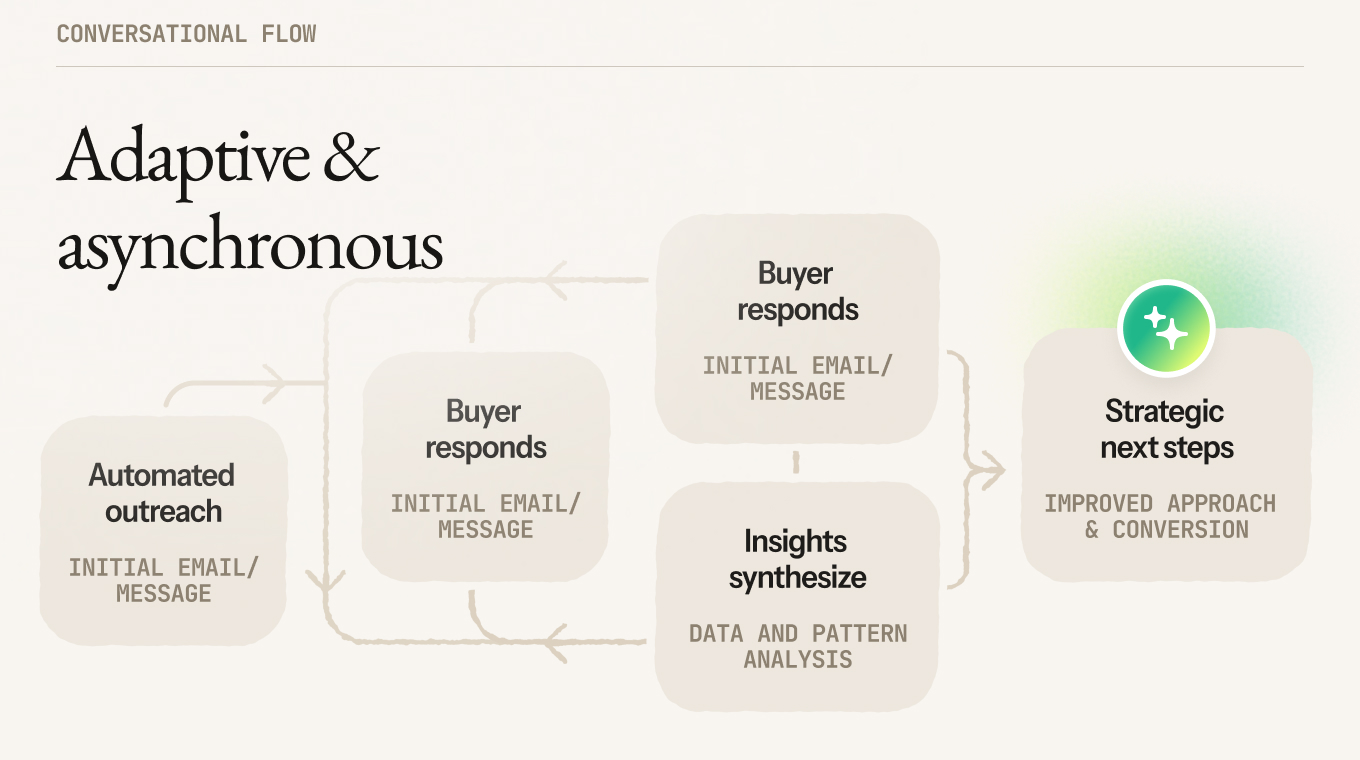
An AI agent reaches out to the buyer with contextual questions about their decision process. What alternatives did they actually evaluate? What factors drove the final decision? Where did your solution fall short? What would have changed the outcome?
The agent adapts the conversation based on their responses. If they mention implementation concerns, it digs into that. If they say budget, it explores whether that was the real constraint or a polite exit.
This is the altitude shift. You stop relying on rep guesses and CRM dropdowns. You get buyer truth at scale, continuously, for every deal.
Want to see what a Propane buyer interview actually looks like? Listen to a real win-loss call where the buyer explains what actually drove their decision.
The agent adapts the conversation based on their responses. If they mention implementation concerns, it digs into that. If they say budget, it explores whether that was the real constraint or a polite exit.
This is the altitude shift. You stop relying on rep guesses and CRM dropdowns. You get buyer truth at scale, continuously, for every deal.
How it works
When a deal closes in your CRM (won or lost), it triggers a Propane agent to engage the buyer. The outreach is contextual, not generic. The agent knows your product, the deal details, and what you're trying to learn.The conversation happens asynchronously. Buyers respond when convenient. The agent follows up based on their answers. The whole exchange takes 10-15 minutes of buyer time spread across a few days.Insights synthesize automatically. You don't read 47 individual interview transcripts. You see patterns. "Enterprise buyers consistently mention integration complexity as the real concern when they say 'too expensive.'" "Mid-market deals lost to Competitor X are actually lost because their sales cycle is 3 weeks and yours is 9."These patterns feed directly into your operations. Your CRM gets accurate loss reasons. Your product team sees what buyers actually need. Your sales team learns what messaging works and what falls flat.
What happens when you interview every buyer:
Companies running systematic buyer interviews catch problems your CRM never flags.
You discover your champion isn't the economic buyer in 73% of enterprise deals. You've been selling to the wrong person.
You learn that "lost to price" usually means "couldn't justify ROI to finance" or "timing wasn't right" or "went with incumbent because switching felt risky." These are different problems requiring different solutions.
You find out competitors you've never heard of are winning deals. They're not in your battlecards because reps didn't know they existed. But buyers evaluated them and chose them over you.
What buyer truth actually unlocks
A B2B platform was losing enterprise deals. CRM said 60% lost to price, 25% to Competitor A, 15% to timing.They ran Propane's automated buyer interviews on every closed deal for 30 days. The real picture: only 18% were actually about price.
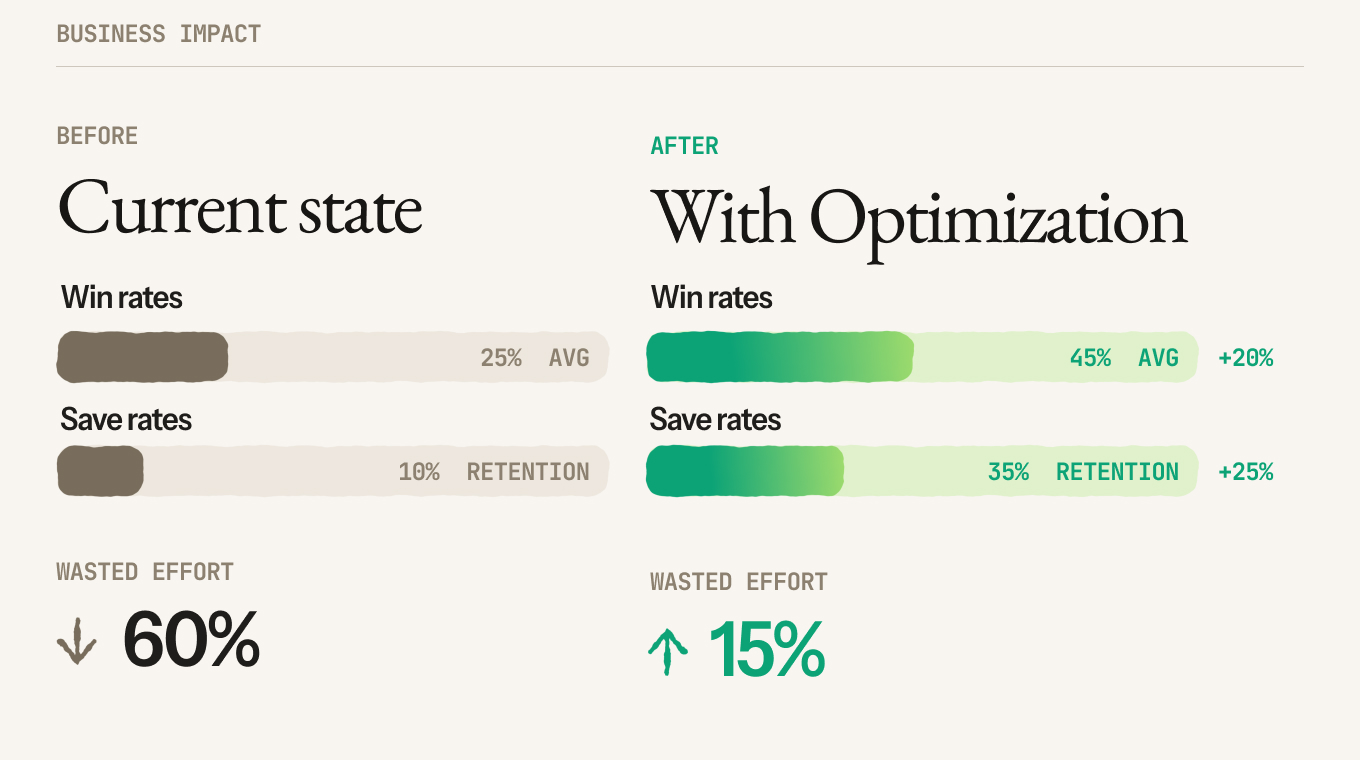
For the VP of Sales: 34% of losses were implementation timeline, not pricing. They built a fast-track option. Win rates on time-constrained deals jumped 41%.
For AEs: 22% lost when champions left mid-deal. They created a transition playbook. Save rate went from 12% to 47%. Reps stopped losing deals to internal politics they couldn't see.
For Product: 16% lost because of a missing integration reps never asked about. They added it to discovery. Deals that would die at contract now die in week one when you can pivot. Wasted pipeline dropped 28%.
For RevOps: CRM loss reasons finally matched reality. Strategic decisions stopped being based on rep guesses. Competitive intelligence became accurate. Battlecards reflected who buyers actually evaluated.The transformation wasn't better CRM hygiene. It was access to truth every role could act on.
None of this was visible in CRM.
What changed
They rebuilt their entire sales process based on buyer truth instead of rep guesses.
They shortened implementation from 12 weeks to 6 by building a fast-track option for time-sensitive deals. Win rates on time-constrained deals increased 41%.
They created a champion-transition playbook for when contacts leave mid-deal. Save rate on deals with champion changes went from 12% to 47%.
They added integration questions to discovery. Deals that would have died at contract stage now die in week one when you can still pivot. Wasted sales effort dropped 28%.
They updated battlecards with the competitors buyers actually evaluated, not the ones reps thought they competed against. Competitive win rates improved across the board.
Most importantly, their CRM loss reasons now matched reality. Strategic decisions were based on what actually happened, not what reps guessed.
Why buyer interviews work when CRM data doesn't
Reps are hired to close deals, not to be data analysts. They're juggling 20-50 active opportunities, running demos, handling objections, and chasing closes. Spending 15 minutes thoroughly documenting why a deal was won or lost means 15 minutes not selling.
So they guess based on limited visibility. They mark the easiest dropdown. They move on to the next deal.
Buyers know because they made the decision. They sat in the room where alternatives were debated. They heard the real objections. They know what actually mattered.
CRM dropdowns capture what's easy to mark. Buyer interviews reveal what actually happened.
Traditional win-loss programs interview 5-10% of deals. AI agents interview 100% at a fraction of the cost.
The breakthrough is scale. When you interview every buyer, patterns emerge that you miss when you cherry-pick. Mid-market segments have different loss reasons than enterprise. Q4 deals fail differently than Q2 deals. First-time buyers churn for different reasons than customers expanding.
You can't see these patterns interviewing 10 deals per quarter. You need hundreds of conversations to identify what's signal versus noise.
Intelligence across the entire GTM journey:
Propane doesn't stop at win-loss. Every GTM moment is a research opportunity.
Website signup?
The agent pre-screens before SDRs reach out. Instead of a static form, buyers have a conversation. "What triggered you to look for a solution?" "What's your current process?" "When do you need this live?" SDRs get qualified leads with context, not just an email and company size.
First customer meeting?
The agent gathers intelligence on their evaluation criteria before your rep even calls. Your AE walks into discovery already knowing what matters.
Demo no-show?
The agent discovers why they ghosted. Was it timing, lost interest, or went with a competitor? You know whether to follow up or move on.
Trial abandonment?
The agent learns what didn't work. Which step blocked them? What were they trying to accomplish? Product sees patterns across all trial dropoffs.
This intelligence flows to everyone who needs it. Sales learns what messaging works. Product sees what features buyers actually care about. Marketing discovers which competitors buyers consider.
When marketing learns something, sales learns it too. When customer success identifies a churn pattern, sales adjusts their qualification. The insights become levers for everyone, not data locked in one team's tool.
Getting started with buyer intelligence
Connect Propane to your CRM and call intelligence platform (Gong, Chorus, etc.). Set up automated buyer interviews for every close, won or lost.
Optional: Add incentives to increase response rates. Offer buyers a $50-100 gift card for completing the interview. Propane handles the delivery automatically.
Let the agents run for 30 days. They're fast, cheap, and time-based so you can run them continuously instead of selectively.
Review the patterns that emerge. Compare what buyers say to what your CRM says. Identify where your revenue strategy is built on inaccurate assumptions.
Update your process based on buyer truth. Change how you qualify, what you demo, how you handle objections, which competitors you prepare for.
Want to see what buyers actually say about why you win and lose? Book a demo.
Your CRM is 85% fiction. Buyer interviews are 100% truth.